
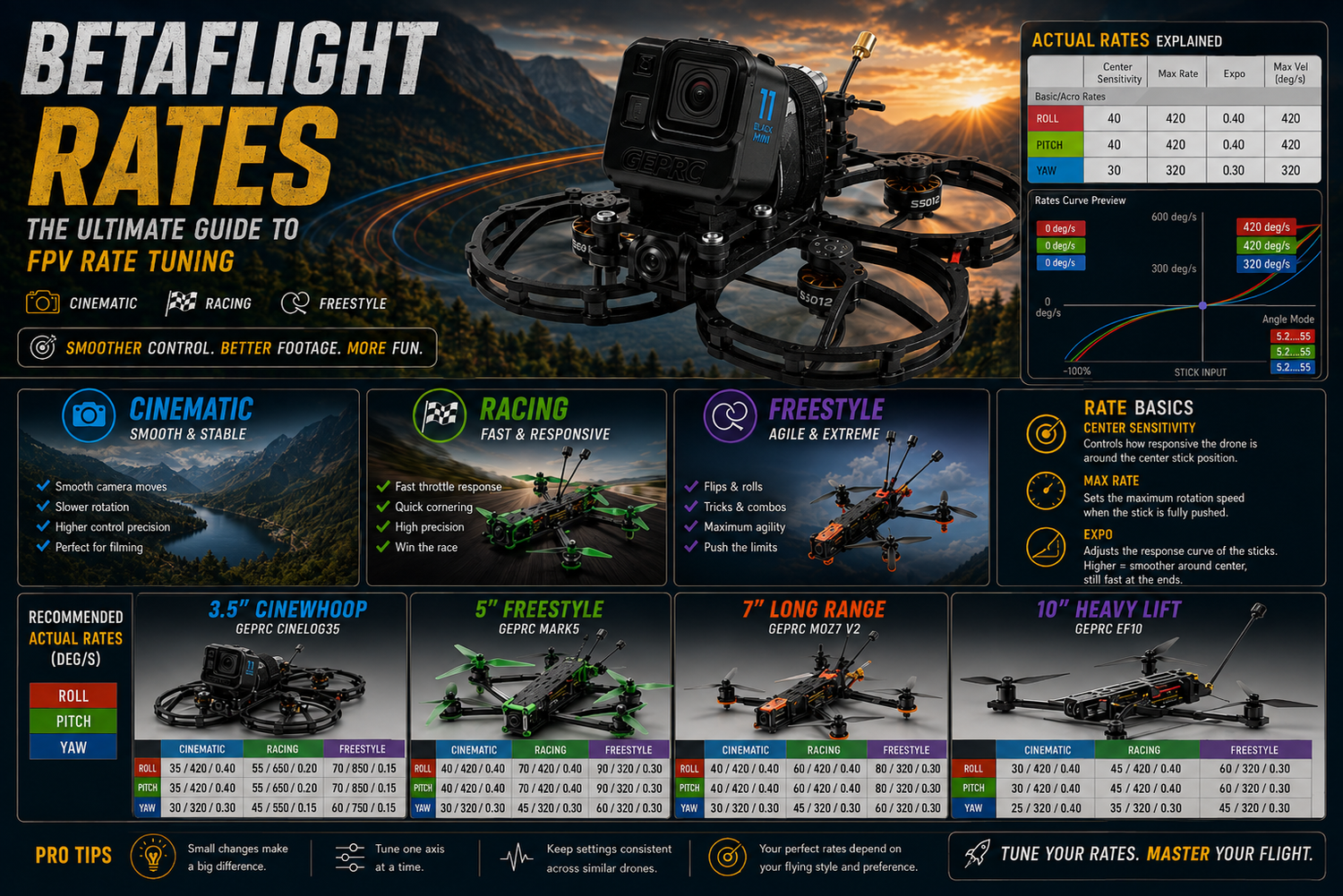
Whether you’re flying a 3.5-inch cinewhoop, a 5-inch freestyle quad, a 7-inch long-range drone, or a 10-inch heavy-lift platform, understanding Betaflight Actual Rates is one of the most important steps in achieving the perfect flying experience.
Many pilots mistakenly believe that higher rates always mean better performance. In reality, the best rates depend entirely on how you fly, the type of drone you use, and the type of footage you want to capture.
This guide explains what each Actual Rates parameter does and provides recommended settings for different drone sizes and flying styles.


⸻
What Are Betaflight Actual Rates?
Actual Rates determine how your drone responds to stick movements.
They do not increase motor power or flight speed. Instead, they determine how quickly the aircraft rotates when you move the sticks.
A properly tuned Rates setup makes your drone feel smoother, more predictable, and easier to control.
⸻
Understanding the Three Main Parameters
1. Center Sensitivity
Center Sensitivity controls how responsive the drone feels when the stick is close to the center position.
Lower Values
* Smoother control
* Better for cinematic flying
* Easier to make small corrections
* Great for beginners
Higher Values
* Faster stick response
* More responsive handling
* Better suited for racing and freestyle
Cinematic Tip:
Roll and Pitch are usually kept identical for balanced handling, while Yaw is often set slightly lower to produce smoother pans and more natural camera movement.
⸻
2. Max Rate
Max Rate determines the maximum rotation speed when the stick is pushed fully to the edge.
Example:
Roll = 420°/s
This means the drone can rotate up to 420 degrees per second on the Roll axis.
Lower values produce smoother camera movement.
Higher values allow much faster flips, rolls, and aggressive maneuvers.
Cinematic Tip:
Many cinematic FPV pilots intentionally reduce the Yaw Max Rate. A slower Yaw produces smoother turns, more controlled orbit shots, and more natural-looking footage.
⸻
3. Expo
Expo adjusts the stick response curve.
It softens stick movements around the center while still allowing full rotation speed when the stick reaches the end of its travel.
Lower Expo
* More direct response
* Better for racing
Higher Expo
* Smoother center-stick control
* Better for cinematic flying
Cinematic Tip:
A slightly lower Yaw Expo can provide more predictable panning while maintaining smooth cinematic control.
⸻
Which Flying Style Are You Using?
1. Cinematic Flying
Best for:
* Landscape photography
* Indoor FPV
* Real estate
* Mountain flying
* Smooth cinematic videos
Characteristics:
* Slow rotation
* Smooth stick response
* Stable camera movements
* Natural panning
⸻
2. FPV Racing
Best for:
* Racing tracks
* Fast cornering
* Competition
Characteristics:
* Instant response
* High precision
* Fast direction changes
⸻
3. Freestyle
Best for:
* Power Loops
* Matty Flips
* Split-S
* Trippy Spins
* Aggressive acrobatics
Characteristics:
* Extremely fast rotation
* Maximum maneuverability
* Instant stick response
⸻
Recommended Actual Rates
3.5-inch Cinewhoop (GEPRC CineLog35)
Cinematic
Axis Center Sensitivity Max Rate Expo
Roll 40 420 0.40
Pitch 40 420 0.40
Yaw 30 320 0.30
Racing
Axis Center Sensitivity Max Rate Expo
Roll 55 650 0.20
Pitch 55 650 0.20
Yaw 45 550 0.15
Freestyle
Axis Center Sensitivity Max Rate Expo
Roll 70 850 0.15
Pitch 70 850 0.15
Yaw 60 750 0.15
⸻
5-inch FPV Drone (GEPRC Mark5)
Cinematic
Axis Center Sensitivity Max Rate Expo
Roll 40 500 0.35
Pitch 40 500 0.35
Yaw 35 380 0.30
Racing
Axis Center Sensitivity Max Rate Expo
Roll 70 800 0.15
Pitch 70 800 0.15
Yaw 60 650 0.15
Freestyle
Axis Center Sensitivity Max Rate Expo
Roll 90 1000 0.20
Pitch 90 1000 0.20
Yaw 75 900 0.20
⸻
7-inch Long Range (GEPRC MOZ7 V2)
Cinematic
Axis Center Sensitivity Max Rate Expo
Roll 40 450 0.35
Pitch 40 450 0.35
Yaw 35 350 0.30
Racing
Axis Center Sensitivity Max Rate Expo
Roll 60 700 0.20
Pitch 60 700 0.20
Yaw 50 550 0.20
Freestyle
Axis Center Sensitivity Max Rate Expo
Roll 80 900 0.20
Pitch 80 900 0.20
Yaw 65 750 0.20
⸻
10-inch Heavy Lift (GEPRC EF10)
Cinematic
Axis Center Sensitivity Max Rate Expo
Roll 30 320 0.45
Pitch 30 320 0.45
Yaw 25 250 0.40
Racing
Axis Center Sensitivity Max Rate Expo
Roll 45 500 0.25
Pitch 45 500 0.25
Yaw 35 400 0.20
Freestyle*
Axis Center Sensitivity Max Rate Expo
Roll 60 700 0.20
Pitch 60 700 0.20
Yaw 45 600 0.20
Note: Most 10-inch drones are designed for heavy payloads and long-range missions. Freestyle flying is generally uncommon and requires a lightweight build with sufficient power.
⸻
Which Settings Should You Choose?
Choose Cinematic if you:
* Shoot landscapes
* Fly indoors
* Create YouTube videos
* Record real estate footage
* Capture travel content
⸻
Choose Racing if you:
* Fly race tracks
* Need maximum precision
* Prefer quick cornering
⸻
Choose Freestyle if you:
* Practice acrobatics
* Perform flips and rolls
* Want maximum agility
⸻
Pro Tips
* Rates are highly personal—fine-tune them to match your flying style.
* Start with conservative values if you’re new to FPV.
* Increase Max Rate gradually as your confidence grows.
* Keep Roll and Pitch consistent across your drones to maintain familiar stick feel.
* For cinematic flying, consider using a slightly lower Yaw Rate for smoother pans and orbit shots.
* Change one parameter at a time, then test-fly before making additional adjustments.
⸻
Final Thoughts
There is no single “perfect” Betaflight Actual Rates setup.
The best configuration depends on:
* Your flying style
* Your drone size
* Your experience level
* The type of footage you want to create
For most cinematic pilots, lower Center Sensitivity, moderate Max Rate, and a slightly reduced Yaw Rate provide the smoothest and most natural camera movements.
Use these recommendations as a starting point, then fine-tune them until the drone feels comfortable in your hands. A well-tuned Rates setup will improve control, increase confidence, and help you capture smoother, more professional FPV footage.